
Nature vs. nurture is one of those psychology topics students think they already understand—until you ask them to actually apply it. Most students walk into class with their minds made up about which matters more: biology or the environment. What I noticed, though, was that while my students were quick to pick a side, they were much slower to consider how the two interacted.
Nature provides the rubber band. Nurture determines how far it gets stretched.
Because of that, I made a change this year. I redesigned my Human Development unit to move students beyond debate into experience. I begin the unit by asking students to examine their assumptions about the lifespan (yes, many are convinced life ends at 50). Next, they engage in a hands-on nature–nurture lab, explore epigenetics and the impact of toxic stress on development. Lastly, they apply everything they’ve learned to the documentaryThree Identical Strangers.
Note: Here is a link to the Canva presentation that I use: Intro to Human Development Presentation.
Unit Flow: Setting the Stage for Deeper Thinking

The unit opens with a “decades” brainstorm, where students list descriptors for each decade of life and decide the “best” and “worst” age to be—past, present, or future. Spoiler alert: Most students are really excited to turn 21, and I’ve never had a student argue that middle school was the best time of their life. This activity is a low-key, low-stress introduction that reveals their assumptions about stability, change, and development across the lifespan.
From there, students move to the Nature–Nurture Station Lab, where they must decide whether certain tasks are nature, nurture, or both.
The Nature–Nurture Lab: Getting Students Out of the Debate and Into the Evidence
I designed this lab as an early anchor in the unit to push students away from opinion-based arguments and toward evidence-based reasoning. The lab is set up with six stations, and students rotate through them in a single 45-minute class period. At each station, clear instructions are posted describing the activity and what students need to observe or decide. They spend about five minutes per station and work individually, in pairs, or in small groups. Here’s a copy of the handout: Nature/Nurture Lab.
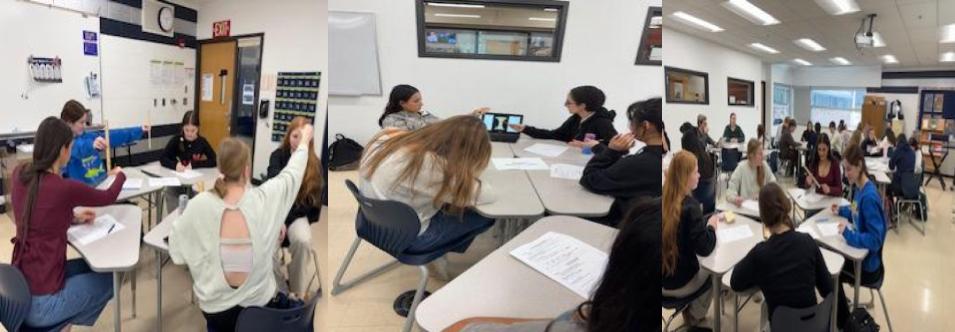
The Stations
- Reaction Time Test: Students test their reaction speed using a simple ruler drop. It feels straightforward – at least until they’re asked whether practice would improve results and why some people are consistently faster than others.
- Attention Split Challenge: Students read a short passage under normal conditions and then again while completing a patterned tapping task. Typically, students experience a drop in performance during the dual-task condition. They experience firsthand how the environment interferes with focus. The materials are on the last page of the Nature/Nurture Lab packet.
- Perception Challenge: Students access these unstable images. They record what they see first and compare responses with their group members. Not all of the students see the same thing initially. This opens up great conversations about how past experiences shape perception.
- Build a Person: Students draw one trait card and one environment card and must explain how the environment could shape the expression of that trait. The catch: they cannot explain the outcome with a single factor.
- Rule Discovery Challenge: Students work together to uncover hidden rules behind patterns. This leads into a conversation about the relationship between math, language, and other experiences on thinking ability.
- Trait Prediction Game: Students predict similarities and differences in identical twins raised apart. Asking students to sort traits as genetic, environmental, or both turns out to be surprisingly difficult.
At every station, students must decide: Mostly Nature, Mostly Nurture, or Interaction. By the end of the lab, most of the students realize it’s a lot more complicated than they thought!
Extending the Thinking: Epigenetics and Ethics
The next day, we take the conversation into epigenetics and the impact of toxic stress on fetal development. I start by breaking down epigenetics in simple terms. We then watch the Harvard Research: Poverty Begins in the Womb. This documentary shows how chronic stress during pregnancy can affect fetal development. It really drives home the point that biology isn’t destiny and that environment really matters.
From there, students apply these ideas to the documentary Three Identical Strangers. After watching, they revisit the nature–nurture debate, evaluate ethical failures, and connect the twins’ outcomes to developmental themes across the lifespan.
Takeaways
Redesigning the opening of this unit has changed the way students talk about development. Instead of rushing to pick a side, they slow down, ask better questions, and support their claims with evidence. I was very happy with The Nature–Nurture Lab, in particular, because it helps students experience complexity rather than just define it.
If you’re looking for a way to kick off nature vs. nurture that goes beyond notes and definitions, this sequence has been a meaningful shift in my classroom. All materials for the Nature–Nurture Lab are linked and ready to use
I’d love to hear how you introduce nature and nurture in your own psychology classes! And, if you try any part of this sequence (or put your own spin on it), I’d love to hear how it goes.
Take Care,
Cori
 Blended Learning Journey
Leave a comment